Call Us Now 1 714 432 9996

Recent
Articles

Reverse Osmosis, RO Systems

Clean water is every human’s right to have, yet today it seemsmore like a privilege to even have access to it. Unfortunately not everyone has easy access to clean potable water. It’s truly heartbreaking how many people in this world go without pure drinking water, and not by choice.

Read More +

Unless you live in a first world country where intricate systems have been put into place for safe and secure water distribution services, you may not have the proper resources to access clean healthy potable water for consumption and everyday use. Many of those who go without are forced to drink dirty unhealthy water. This exposes them to harmful water borne illnesses that cause extreme sickness and even death. With clean drinking water becoming scarce in many regions of the world, specifically third world and desert communities, reverse osmosis RO water treatment systems are becoming more and more popular in the pursuit of clean water. These systems take unhealthy, brackish, dirty water and turn it into potable drinking water suitable for human consumption and everyday use. Many countries are coming to recognize the benefits of having such units to clean their water.

The way RO reverse osmosis systems work: Water pressure is used to force water molecules through a very fine membrane leaving the contaminants behind. Purified water is collected from the permeate side of the membrane, and water containing the concentrated contaminants, i.e. iron, chlorine, mud, etc. is flushed down the drain from the concentrate side. The average reverse osmosis system is a unit consisting of a multimedia and activated carbon pre filter, a softener with brine tank, the reverse-osmosis unit with semi-permeable membranes, and a UV sterilizer post treatment; the UV is especially important if the water is to be stored for an extended period of time. This is done so that it does not spoil and breed bacteria. Then all the effort it took to process the water would have been in vain. Of course there are variations in pre and post treatment depending on the size of the system, capacity and application it is needed for.

Reverse osmosis removes salt and most other inorganic material present in the water, and for that reason, reverse osmosis lends itself to use in places where the drinking water is brackish, contains nitrates or other dissolved minerals which are difficult to remove by other methods. We have to remember that water is our most precious resource. It is what gives this planet and every living thing existing on it life. It’s for that reason that we need to protect it and preserve it at all costs. This is why reverse osmosis RO is such an important engineering and technological accomplishment. Building systems such as these can potentially save countless lives in the pursuit of clean water. This is why having a quality water system makes a difference. So do Mother Nature a favor and help keep her water clean, this way future generations can enjoy all she has to offer.
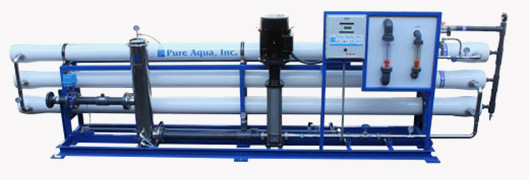
This powerful R0-400 reverse osmosis system was carefully designed to carry out the process of reverse osmosis to successfully produce 108,000 GPD for a well water feed. To read more about reverse osmosis,

Collapse -
Reverse Osmosis Systems

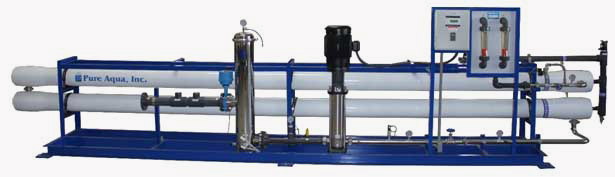
When it comes to water treatment and purification, technology has improved the way people can filter and clean unhealthy water. Reverse Osmosis Systems are units that can do just that; clean and remove salt from dirty water. With this technology, we can utilize water that we never could in the past.

Read More +

River water, sea water, well water, estuary water, etc., almost any type of water can be cleaned using the proper reverse osmosis system. When there is a water shortage or drought or just bad water, reverse osmosis systems can get the job done.

How they work: water pressure is used to force water molecules through a very fine membrane leaving the contaminants behind. Purified water is collected from the "clean" or “permeate” side of the membrane, and water containing the concentrated contaminants is flushed down the drain from the "contaminated" or “concentrate” side. The average reverse osmosis system is a unit consisting of a multimedia and activated carbon pre filter, a softener with brine tank, the reverse-osmosis unit with membranes, and a UV sterilizer post treatment; this is especially important if the water is to be stored for an extended period of time.

Reverse osmosis removes salt and most other inorganic material present in the water, and for that reason, reverse osmosis lends itself to use in places where the drinking water is brackish (salty), contains nitrates or other dissolved minerals which are difficult to remove by other methods. Using a quality carbon filter to remove any organic materials and chemicals that get through the sediment pre-filter, the purity of the treated water approaches that produced by distillation.

Reverse Osmosis systems are advancing more as new technologies are being discovered and implemented. They vastly improve the lives of those who are affected by lack of clean water. They also assist in commercial and industrial applications where mass amounts of purified water are needed. They are a very good investment to ensure the health and safety of most any water source.

Collapse -

The Process of Reverse Osmosis

Reverse osmosis is a pressure driven process that forces water through a semi-permeable membrane that only passes the solvent (or water). The solute or larger molecules are concentrated and flushed out in the reject stream. RO removes approximately 99+% of dissolved salts in water. To understand the concept of reverse osmosis, recall the process of osmosis.

Read More +

Everything in nature wants to reach equilibrium. If there were two bodies of water separated by a semi-permeable membrane with different salt concentrations, they will reach equilibrium through osmosis; the solvent or water moves naturally through the membrane from the low salt concentration side to the high salt concentration side to balance (put in equilibrium) the concentration. Reverse Osmosis uses pressure to ‘reverse’ the natural flow of the permeate back to the reject stream.

TDS or ‘Total Dissolved Solids’ is a measure of the amount of salts or dissolved ions in water. It is the weight of remaining salts after the water has been filtered and the water evaporated, measured in mg/l which is equivalent to ppm or parts per million. The TDS or amount of salt in water varies from close to zero to seawater which is 36,000 ppm, depending on the region, higher TDS levels are seen in the red sea (up to 45,000 ppm). As a rule of thumb, 10 PSI per 1,000 ppm of TDS contributes 10 PSI of osmotic pressure. Therefore the higher the TDS, the higher pressure to required to overcome the osmotic pressure. Again Reverse Osmosis removes dissolved ions (salts), rejection is 99%+ depending on the membrane and specific ions. The WHO guideline or drinking water standard is 500 ppm.

Reverse Osmosis membranes are sheets rolled into a spiral. Cross flow technology is utilized to flush out the concentrated solutes. Water flows over the surface of the membrane, the solutes or salts are rejected while the solvent is forced through the membrane into the permeate spacer. The recovery is a function of the scaling potential of the feed water. RO systems do not run at 100% recovery as the solutes would precipitate out (form a solid), similar to the scale found on shower heads, kettles, etc. Reverse Osmosis concentrates salts in the reject stream, for example, if the feed is 1000 ppm TDS and the system runs at 75%, the reject would be approximately 4000 ppm and permeate stream 10 ppm.

Reverse osmosis lends itself to use in places where the drinking water is brackish (salty), contains nitrates or other dissolved minerals which are difficult to remove by other methods. In addition to anthropogenic sources of contaminated water, there are ‘naturally’ contaminated sources of water such as well water with high arsenic levels. While water is plentiful, over 97% is too salty for human consumption. Desalination utilizes the unlimited supply of seawater and through Reverse Osmosis, creating potable water by removing the salts. In addition to potable water, there are several other applications: food industry, car washing, boiler feed water, etc.

Reverse Osmosis systems consist of an intake (open or beach well) or supply of water, pre-treatment filters (screen and multimedia filters), Reverse Osmosis (RO) membranes and chemical dosing systems. Pre-treatment is required to remove any suspended solids before being pumped to the RO. The RO membranes remove dissolved solids only, splitting the feed water into permeate (potable water) and reject (concentrated salts). The process of Reverse Osmosis requires significant feed pressure depending on the TDS and temperature. The feed pressure ranges from 75-900 PSI.

Reverseosmosissystem.co, is a global leader in the supply of packaged/skidded Reverse Osmosis systems. Reverseosmosisystem.co is an OEM or system/equipment integrator specializing in membranes. The company works closely with membrane and equipment manufactures to package custom reverse osmosis systems.

Please visit www.reverseosmosissystem.co for your commercial and industrial water treatment solutions.

Collapse -