Have you ever wondered how water coming from wells, lakes, and even the sea can be purified enough to be drinkable or even benefit our commercial and industrial needs?
Naturally, these water sources were created having molecules and particles residing within them due to a force called “Osmosis”.
Osmosis: is the natural force that draws a dilute solution towards a more concentrated solution.
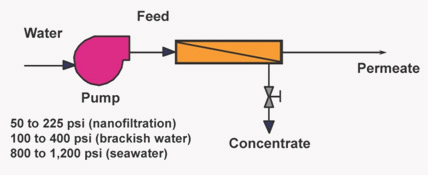
A method came about to reverse this natural process. This method became known as “Reverse Osmosis”. Reverse Osmosis is a process that utilizes a pump to apply sufficient pressure to diffuse water, not salt, through a semi-permeable membrane in a direction opposite of the natural osmotic flow. Diffusion, as it relates to water, is defined as moving molecules and particles from a high level concentration to a low one.
What It Can Do?
Obtain purified water from a feed stream (permeate)
Extract constituents from a feed stream (concentrate)
Selectively separate small ions and molecules.
What It Can't Do?
Cannot concentrate to 100%
Cannot separate to 100%
Not always the most effective method
Reverse Osmosis cannot be mastered without the use of Reverse Osmosis Systems. In the 1980’s, genuine sea reverse osmosis membranes and systems were available commercially. The use of these systems allowed the process of reverse osmosis to be considerably less costly than most other desalination processes. Much of today’s optimization efforts have been in the areas of using less energy in the process. Today’s seawater RO elements are able to use much product at 650 PSI applied pressure. These Systems were created to treat brackish and sea waters.